
May 18, 2026
iseinsagency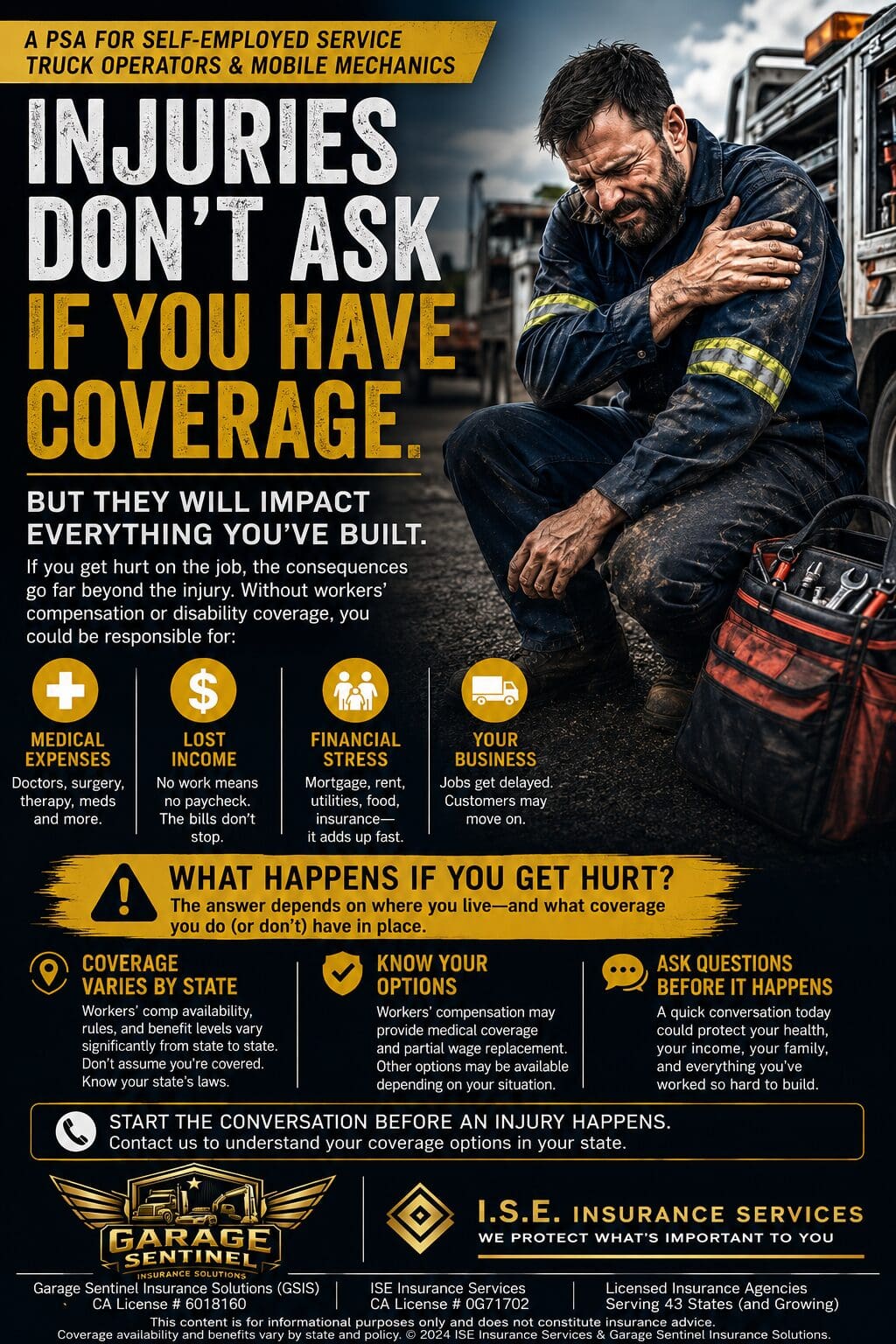
What Happens If a Self-Employed Service Truck Operator Gets Hurt on the Job?
A PSA for Mobile Mechanics, Diesel Technicians & Equipment Repair Operators
From ISE Insurance Services + Garage Sentinel Insurance Solutions (GSIS)
This Isn’t a Sales Pitch. It’s a PSA.
Recently, one of our customers—a hardworking self-employed service truck operator—was injured while working.
Now he’s facing questions a lot of people in this industry never fully think through until it’s too late:
- How do the bills get paid?
- What happens to income while recovering?
- What if you physically can’t work for months?
- What protections actually exist for self-employed operators?
The difficult reality is this:
👉 Many mobile mechanics, diesel technicians, and service truck operators assume protections exist that may not actually be there.
And by the time they realize it, they’re already hurt.
That’s why we felt this conversation needed to happen.
This isn’t about fear.
It’s about making sure hardworking people understand the risks before they’re forced to learn them the hard way.
The Risk Most Self-Employed Operators Don’t Think About
When you work for someone else, there’s usually an assumption that:
- Workers’ compensation exists
- Medical bills may be covered
- A portion of lost wages may continue
- There’s at least some type of safety net in place
But once you become self-employed—especially as:
- A mobile mechanic
- Diesel technician
- Service truck operator
- Heavy equipment repair contractor
- Independent fleet service provider
…a lot of those protections may disappear unless you intentionally put them in place.
And many operators don’t realize that until something bad happens.
“I Have an LLC… Doesn’t That Protect Me?”
This is one of the most common misunderstandings we hear.
An LLC may help create separation between personal and business liability in some situations.
👉 It does NOT automatically replace income if you’re injured and unable to work.
It also does not automatically:
- Pay your medical bills
- Cover lost income
- Protect your family financially during recovery
That’s an entirely separate issue.
If You’re Self-Employed and Injured on the Job, Who Pays?
The answer depends on:
- Your state
- Your business structure
- Whether workers’ compensation exists
- Whether disability coverage exists
- Whether occupational accident coverage exists
- And what exclusions may apply
For many self-employed operators:
- No work = no paycheck
- Medical bills continue
- Mortgage and utilities continue
- Truck payments continue
- Customers may move on
That’s why understanding your options BEFORE an injury matters.
What Workers’ Compensation Can Do
Depending on the state, workers’ compensation coverage may provide:
- Medical expense coverage for work-related injuries
- Partial wage replacement while recovering
- Disability-related benefits
- Rehabilitation or ongoing care in some situations
But the rules vary significantly by state.
And Here’s Where Things Get Complicated
For self-employed operators, LLC owners, and independent contractors:
👉 Workers’ compensation availability is NOT the same everywhere.
Some states:
- Allow owner-operators to elect coverage
- Strongly encourage it
- Require it in certain situations
Other states:
- Have restrictions
- Different benefit structures
- Different eligibility rules
- Different exemptions for owners or LLC members
The important point is this:
You should never assume you are covered.
What Happens Without Coverage?
This is the part most people avoid thinking about.
If you’re injured and unable to work:
- Revenue may stop immediately
- Customers may move elsewhere
- Medical bills can pile up quickly
- Your family may suddenly depend on savings—or debt
For many self-employed operators:
👉 If they don’t work, they don’t get paid.
That’s the reality.
Injuries Happen Faster Than People Think
In this industry, injuries don’t have to be catastrophic to create financial problems.
Sometimes it’s:
- A back injury
- A crushed hand
- A shoulder injury
- A fall
- A knee injury climbing on equipment
- A vehicle accident during a service call
You don’t necessarily have to be permanently disabled to be financially devastated.
Sometimes being unable to work for even a few months is enough to create major pressure.
This Blog Isn’t About Selling Fear. It’s About Understanding Your Options.
Not every operator will choose workers’ compensation.
Not every state handles it the same way.
And for some businesses, there may be other solutions worth discussing, including:
- Disability coverage
- Occupational accident policies
- State-specific workers’ compensation options
- Alternative risk management approaches
The important thing is understanding:
- What IS covered
- What ISN’T covered
- And what happens if you’re unable to work tomorrow
📞 Start the Conversation Before You Need It
If you’re self-employed and unsure:
- whether you have workers’ compensation,
- whether you qualify for it,
- what happens if you get hurt,
- or whether your family is financially protected—
ask the question now instead of after an injury.
You can:
- Call us: 📞 (888) 945-1495 Ext 101
- Start with the automated attendant: 📞 (888) 977-1695
- Submit a web inquiry
- Or simply talk with your current agent
The important thing is making sure you understand your options before something happens.
Why We’re Talking About This
At ISE Insurance Services and Garage Sentinel Insurance Solutions (GSIS), we work with mobile mechanics, diesel repair businesses, service truck operators, and equipment repair operations across 43 states nationwide.
And after recently watching a very good customer deal with this situation firsthand, it became clear that more people in this industry need to have this conversation.
Because the question isn’t just:
“Do I have insurance?”
The real question is:
“If I get hurt and can’t work… what happens next?”
❓ Common Questions
Can self-employed mobile mechanics get workers’ compensation?
In many states, yes—but eligibility rules and availability vary significantly.
Does health insurance replace lost income?
Typically no. Health insurance may help with medical expenses, but usually does not replace income.
What if workers’ compensation isn’t available to me?
Depending on the situation and state, there may be other options worth discussing, including disability or occupational accident coverage.
Is workers’ compensation required for owner-operators?
That depends on the state, business structure, and number of employees involved.
Final Thought
Most people in this industry prepare for damage to their truck.
Very few prepare for damage to themselves.
But the reality is:
- trucks can be repaired,
- tools can be replaced,
- businesses can recover—
but an injury to the owner/operator affects everything:
- income,
- family,
- customers,
- and the future of the business itself.
This isn’t about fear.
It’s about making sure hardworking people understand the risks before they’re forced to learn them the hard way.
⚖️ Compliance, Licensing & Experience
ISE Insurance Services and Garage Sentinel Insurance Solutions (GSIS) operate as licensed insurance agencies serving clients in 43 states nationwide (and growing).
- ISE Insurance Services – CA License # 0G71702
- Garage Sentinel Insurance Solutions (GSIS) – CA License # 6018160
With more than 50 years of combined experience, we specialize in helping mobile service businesses understand complex insurance and risk management issues.
Categories: Agency, Auto Aftermarket, Blog, Business/Commercial, diesel repair, Forklift, Garage Liability Insurance, independent auto dealers, Tire Sales and Service, truck repair, Workers Comp
Tags: Diesel Mechanic Insurance, Disability Insurance for Contractors, Garage Sentinel Insurance Solutions, Heavy Equipment Mechanic Insurance, Injured While Self-Employed, ISE Insurance Services, Lost Income After Work Injury, Mobile Mechanic Insurance, Mobile Mechanic Workers Comp, Occupational Accident Insurance, Self-Employed Workers Compensation, Service truck insurance, Service Truck Operator Insurance, Workers Comp for Owner Operators, Workers Compensation for Self-Employed Mechanics